built with live-html
DeepSeek-V4
towards million-token context, efficiently
A ground-up walkthrough: motivation → architecture → hybrid attention → residual upgrade → optimizer → infrastructure → training → results, with prior-art context for every component.
paper: DeepSeek-V4 preview, DeepSeek-AI · 58 pages · arXiv preview, Apr 24 2026
checkpoints: huggingface.co/collections/deepseek-ai/deepseek-v4

1 · the problem

two pressures meet a quadratic wall


test-time scaling pushed token budgets up

  • process supervision & long CoT: Let's Verify Step by Step (Lightman 2023)
  • OpenAI o1 / o3 — paid compute scales answer quality
  • DeepSeek-R1 (Jan 2025): pure-RL reasoning, >32K tokens per answer is normal
  • agentic loops: tool calls, repos, deep research → 100K–1M effective context

vanilla attention is the bottleneck

  • O(n²) compute, O(n) KV memory per layer
  • at 1M tokens, KV cache and bandwidth dominate over weights
  • cheap 1M-token inference — not just training — is the gating constraint

what V4 promises

1,000,000tokens of native context
27%of V3.2 single-token FLOPs (V4-Pro)
10%of V3.2 KV cache size (V4-Pro)
~2 %of BF16-GQA8 baseline KV at 1M
V3.2 already had sparse attention (DSA). V4 wins more headroom by attacking a different axis — compressing groups of m tokens into single KV entries before selection. Savings stack multiplicatively with DSA's.
Lightman+ 2023 2305.20050 DeepSeek-R1 2501.12948 Vaswani+ 2017 1706.03762

2 · the family — and the headline figure

two MoE models, one recipe


V4-FlashV4-Pro(V3.2 ref)
total params284B1.6T671B
activated / token13B49B37B
transformer layers4361
hidden d40967168
routed experts256 (top-6)384 (top-6)
pre-train tokens32T33T
context1M1M128K

Flash efficient reasoning at smaller budget Pro flagship; "Pro-Max" = max reasoning effort

First two layers use pure sliding-window attention. The first three MoE layers use Hash routing instead of learned routing.
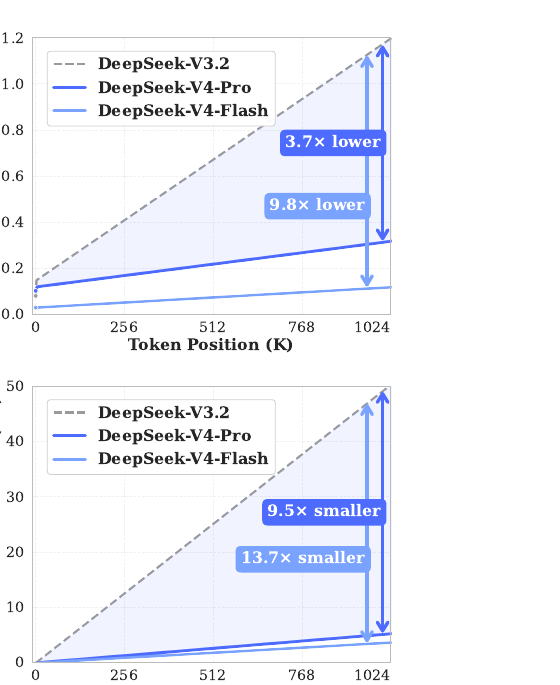
V4 vs V3.2 FLOPs and KV cache scaling
paper Fig 1 (right) — single-token FLOPs and accumulated KV cache vs sequence length. V4-Pro 3.7×/9.5× lower than V3.2; V4-Flash 9.8×/13.7× lower.

3 · architecture, big picture

V3 lineage with three deliberate upgrades


kept from V3

  • DeepSeekMoE: shared + fine-grained routed experts (Dai+ 2024)
  • Multi-Token Prediction (MTP) auxiliary loss
  • auxiliary-loss-free load balancing + slight seq-wise loss

new in V4

  • Hybrid attention: CSA + HCA interleaved (replaces V3.2's DSA-on-MLA)
  • mHC: manifold-constrained hyper-connections (residual upgrade)
  • Muon optimizer (with AdamW for embeddings, head, RMSNorm, mHC statics)

small but notable

  • routing affinity: Sigmoid → Sqrt(Softplus)
  • removed cap on routing target nodes
  • first 3 MoE layers use Hash routing
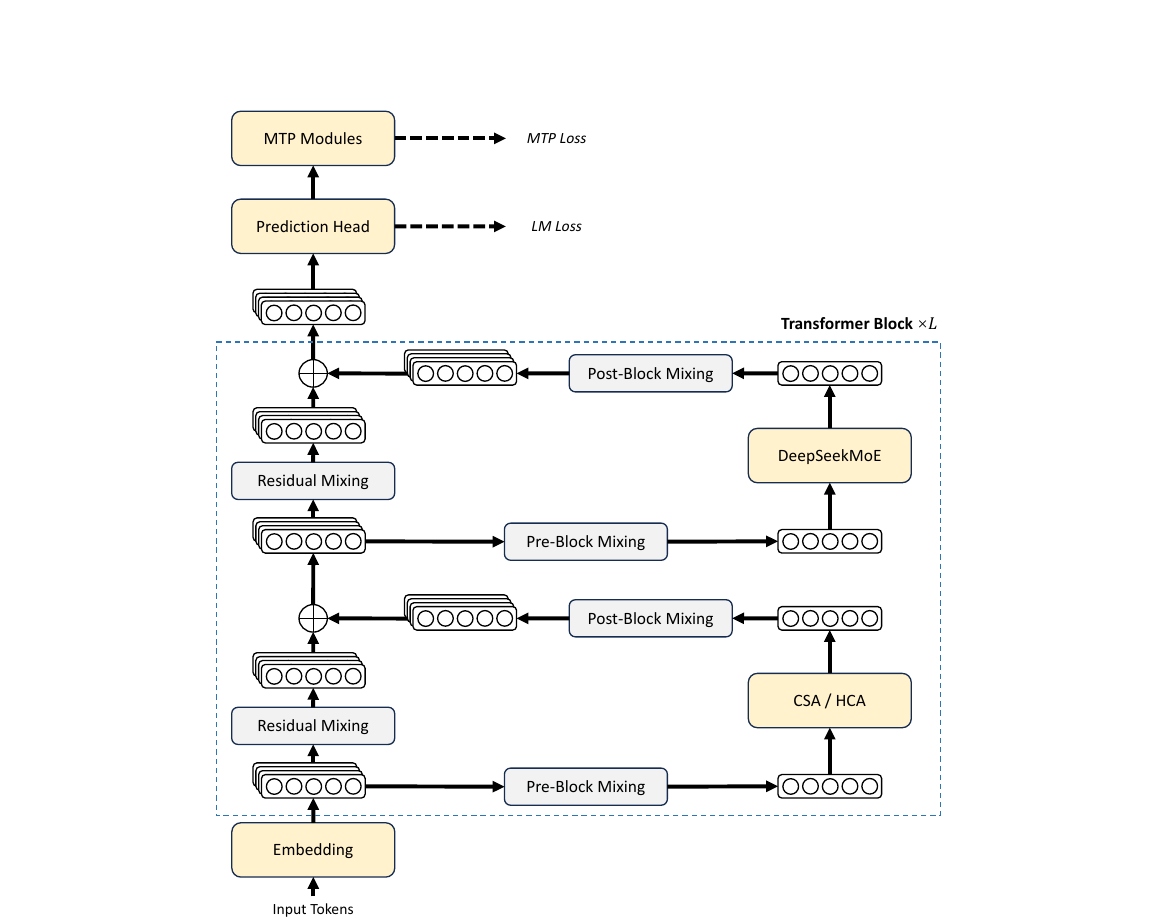
DeepSeek-V4 overall architecture
paper Fig 2 — transformer block: pre/post mixing through CSA or HCA and DeepSeekMoE; mHC residual stream; LM head + MTP modules.
DeepSeekMoE 2401.06066 DeepSeek-V2 (MLA) 2405.04434 DeepSeek-V3 2412.19437 MTP / Gloeckle 2024 2404.19737

4 · background — attention & KV cache

the concepts every later slide builds on


standard self-attention

for each query token t, scores against all preceding keys:

softmax( Qt Kᵀ / √d ) · V
  • compute: n × n — quadratic in sequence length
  • decode: cache K, V per layer → KV cache grows with n
  • at long n, KV memory & bandwidth dominate, not weights

known knobs to attack the cost

  • MQA / GQA / MLA: shrink KV across heads or via low-rank latent
  • sliding window: each token sees only last w tokens
  • sparse selection: pick top-k relevant keys per query (DSA)
  • compression / pooling: pool blocks of m tokens → 1 entry
  • linear / SSM: rewrite as kernel or recurrent state — constant memory but lossy recall

V4 = compression + sparse selection + sliding window + attention sink, in two complementary regimes.

MQA Shazeer 2019 1911.02150 GQA Ainslie+ 2023 2305.13245 MLA / DeepSeek-V2 2405.04434 RoPE Su+ 2021 2104.09864

4b · prior work map for long-context attention

what people tried before V4


yearmethodidea in one linearxiv
2019Sparse Transformers (Child+)fixed strided/factorized patterns, O(n√n)1904.10509
2020ReformerLSH bucketed attention, O(n log n)2001.04451
2020Longformer / BigBirdsliding window + global tokens, linear cost2004.05150 · 2007.14062
2020Linformer / Performer / Linear T.low-rank or kernel approximation of softmax2006.04768 · 2009.14794 · 2006.16236
2023RWKV / Mamba / Mamba-2recurrent / selective SSMs, constant state2305.13048 · 2312.00752 · 2405.21060
2024Attention Sink / StreamingLLMkeep first tokens to absorb attention mass2309.17453
2024MLA (DeepSeek-V2)low-rank latent KV with decoupled RoPE2405.04434
2025NSA — Native Sparse Attentioncompress + select + window, end-to-end trainable2502.11089
2025MiniMax-01 (Lightning Attn)linear attention at 456B-MoE, 4M extrapolate2501.08313
2025DSA (DeepSeek-V3.2)lightning indexer + top-k on top of MLA2512.02556
2026CSA + HCA (V4)two interleaved compression regimes + indexer in FP4(this paper)
Pattern in the field: either linear-time but lossy (SSM, lightning) or exact but expensive (sparse-windowed full). V4's contribution is to stack two compression regimes at different block sizes rather than picking one — CSA preserves detail, HCA absorbs global context.

5 · the headline idea — hybrid attention

two compression regimes, interleaved across layers


CSA — Compressed Sparse Attention

  • compress every m KV tokens → 1 entry  m=4
  • then a lightning indexer picks top-k compressed entries
  • + small sliding window for local detail
  • preserves fidelity; sparsity is the speedup

HCA — Heavily Compressed Attention

  • compress every m' tokens → 1 entry  m'=128
  • dense attention over compressed sequence (no top-k)
  • + small sliding window
  • extreme cache reduction; relies on heavy summarization

what is genuinely new vs prior sparse attention

NSA DeepSeek 2025 2502.11089 DSA / V3.2 2512.02556 Streaming/Sink Xiao+ 2024 2309.17453

5a · CSA in detail

compress, then sparsely select


step 1 — token-level compressor

  • two KV streams Cᵃ, Cᵇ + softmax weights Zᵃ, Zᵇ
  • each compressed entry pools 2m raw entries (overlapping windows on Cᵇ)
  • net: sequence length reduced to n/m

step 2 — lightning indexer

  • cheap MQA-style scorer in FP4
  • index score It,s via low-rank query ↔ compressed key
  • retain top-k (Flash: 512, Pro: 1024)

step 3 — core attention

  • shared-KV MQA over selected blocks + sliding window
  • grouped output projection keeps the projection matrix tractable
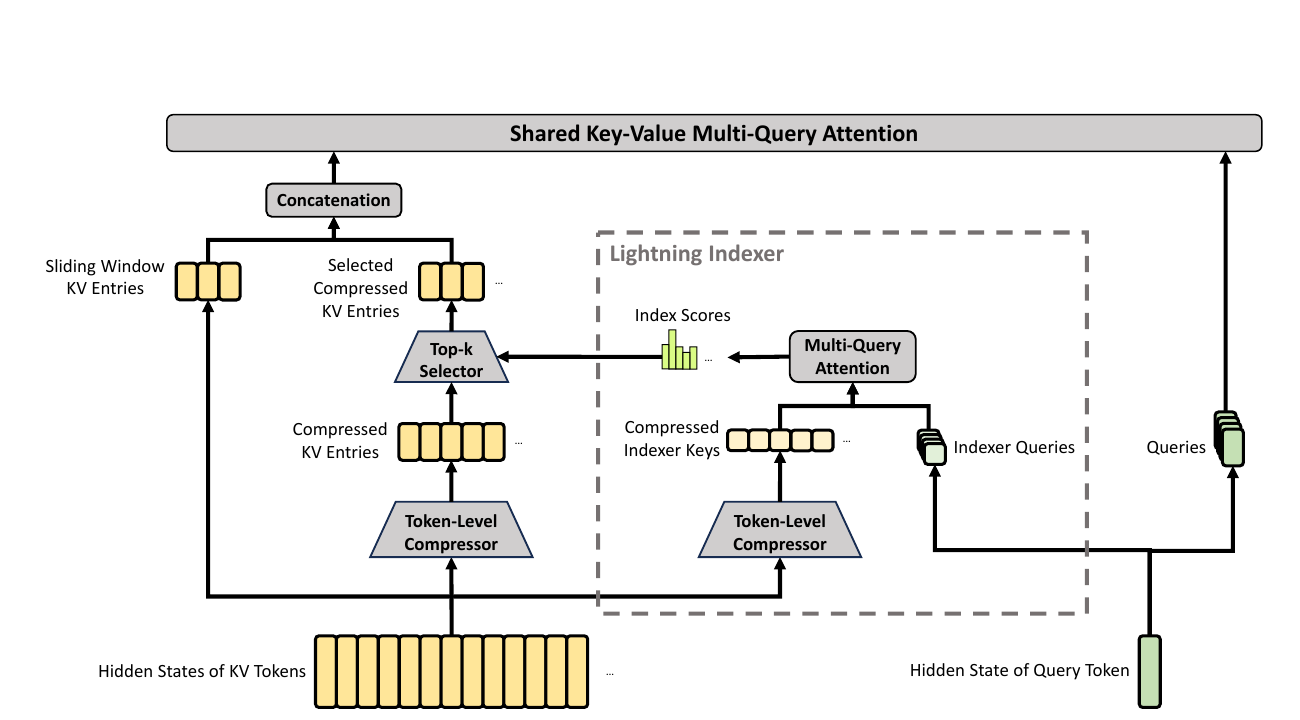
CSA architecture
paper Fig 3 — token-level compressor → lightning indexer → top-k selection → shared-KV MQA, with a sliding-window branch alongside.
NSA Yuan+ 2025 2502.11089 DSA / V3.2 2025 2512.02556 MXFP4 OCP spec 2023 opencompute.org

5b · HCA + the small-but-important bits

and where the 2% KV figure comes from


HCA flow

  • single compressor, no two-stream overlap
  • m' = 128 → 128× cache shrink on the compressed branch
  • dense MQA over compressed entries + sliding window
  • same shared-KV + grouped output projection as CSA

shared tricks for both

  • RMSNorm on Q & KV → no exploding logits, no QK-Clip needed
  • partial RoPE on last 64 dims; trick of adding RoPE at −i on outputs to recover relative position after compression
  • extra sliding-window branch for local fidelity
  • attention sink logit added to denominator — heads can attend to ~0
QK-Clip / Liu+ 2025 2502.16982 RoPE 2104.09864
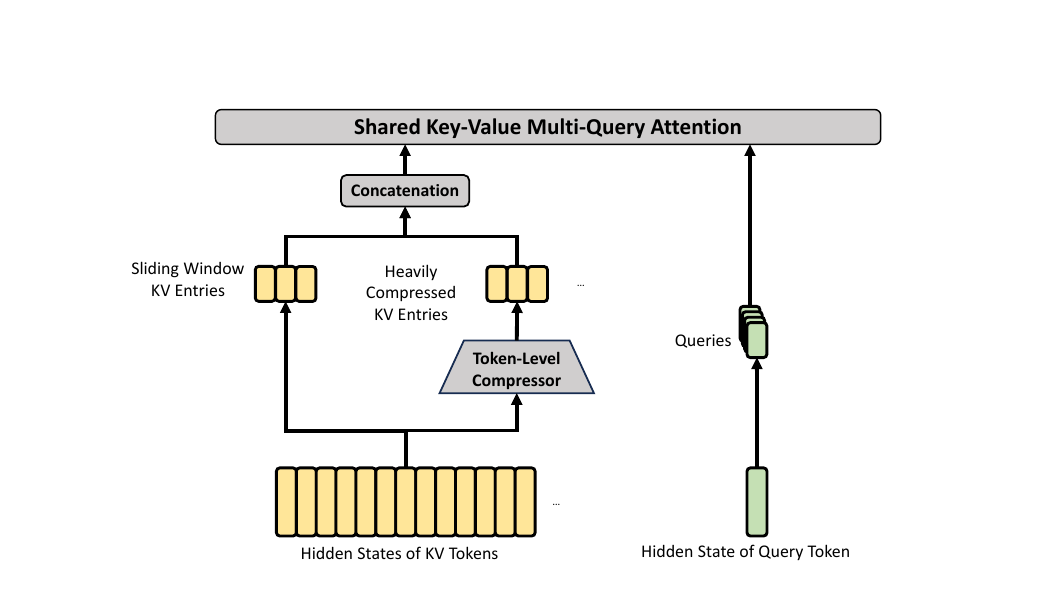
HCA architecture
paper Fig 4 — HCA: single heavy compressor, dense MQA, sliding-window branch.
Combined storage tricks (FP8 KV with BF16 RoPE dims; FP4 indexer attention) plus smaller top-k bring V4 to ~2% of BF16-GQA8 baseline KV at 1M context.

6 · residual upgrade — mHC

manifold-constrained hyper-connections


recap: hyper-connections (Zhu+ ICLR 2025)

  • generalize residual stream Rd → Rnhc×d
  • three small linear maps per layer: A (input), B (residual), C (output)
  • update: Xl+1 = B·Xl + C·𝓕l(A·Xl)
  • breaks the gradient-vanishing / collapse seesaw; subsumes DenseNet
  • matches baseline LM loss with ~½ the tokens — but unconstrained B drifts past ‖·‖2=1, breaking trillion-param stacks

mHC fix (Xie+ 2026)

  • constrain B to doubly stochastic matrices (Birkhoff polytope)
  • ‖B‖2 ≤ 1 → residual map is non-expansive
  • set is closed under multiplication → arbitrarily deep stacks stay stable
  • A, C bounded non-negative via sigmoid → no signal cancellation

how they enforce it

  • A = σ(Ã),   C = 2σ(C̃)
  • project B̃ via Sinkhorn-Knopp (1964/67) — same algo as entropic OT (Cuturi 2013)
    • M(0) = exp(B̃)
    • iterate row + col normalize (tmax=20)
First (to our knowledge) deployment of doubly-stochastic projection inside the forward pass of a trillion-param LLM as a structural stability guarantee — not just as a regularizer on attention or MoE routing.

siblings in Lipschitz-control land

  • spectral norm reg (Miyato+ 2018)
  • weight orthogonalization
  • ReZero (Bachlechner+ 2020)
HC Zhu+ 2024 2409.19606 mHC Xie+ 2026 2512.24880 Sinkhorn / OT Cuturi 2013 1306.0895 SpectralNorm Miyato+ 2018 1802.05957 ReZero 2020 2003.04887

7 · optimizer — Muon

orthogonalized updates for hidden weights, at trillion scale


recipe

Gt  = ∇L(Wt-1)
Mt  = μ Mt-1 + Gt
O't = HybridNewtonSchulz(μMt+Gt)   # ≈ U VT from SVD
Ot  = O't · √max(n,m) · γ
Wt  = Wt-1(1 − ηλ) − η Ot
      

hybrid Newton-Schulz

  • 10 iterations, 2 stages:
    • fast (×8): (3.4445, −4.7750, 2.0315) — push σ toward 1 from anywhere
    • stabilize (×2): (2, −1.5, 0.5) — lock σ ≈ 1
  • approximates Q from SVD without computing one

why this is exciting

  • orthogonalization = steepest descent in spectral norm (vs Adam's element-wise rescaling) — sharper geometry for matrix-valued params
  • theoretical lineage: Shampoo, Bernstein & Newhouse Modular Duality (2024) — Muon is the lightweight, preconditioner-free realization
  • first credible AdamW challenger to win at frontier scale:
    • Liu+ 2025 (Moonlight, 16B-active) — ~2× token efficiency vs AdamW
    • V4 (1.6T total) — largest known Muon deployment to date
    • RMSNorm on Q/KV removed need for QK-Clip stabilization

training-stability extras

  • anticipatory routing — route with previous-step params; auto-engages around loss spikes
  • SwiGLU clamping — linear branch ∈ [−10, 10], gate ≤ 10
Muon Jordan 2024 kellerjordan.github.io/posts/muon Liu+ 2025 Moonlight 2502.16982 Modular Duality 2024 2410.21265 Shampoo 2018 1802.09568 AdamW 2017 1711.05101

8 · infrastructure

what makes 1.6T × 1M tractable


MoE expert parallelism

  • fuse dispatch + linear-1/2 + combine into one pipelined kernel
  • split experts into waves; comm of next wave hides under compute of current
  • theoretical 1.92× speedup vs naive — vs Comet's 1.42×
  • lineage: GShard, Switch, TUTEL, FasterMoE, COMET, DeepEP

kernels & precision

  • TileLang — tiled DSL, 1.36–1.70× over Triton/FlashAttn-3
  • batch-invariant deterministic kernel libs → bitwise reproducible train↔infer
  • FP4 (MXFP4) QAT for MoE expert weights and indexer QK path

training framework

  • tensor-level activation checkpointing (extended autograd)
  • hybrid ZeRO tailored to Muon
  • fused / recompute path for cheap mHC
  • two-stage contextual parallelism for compressed attention at 1M
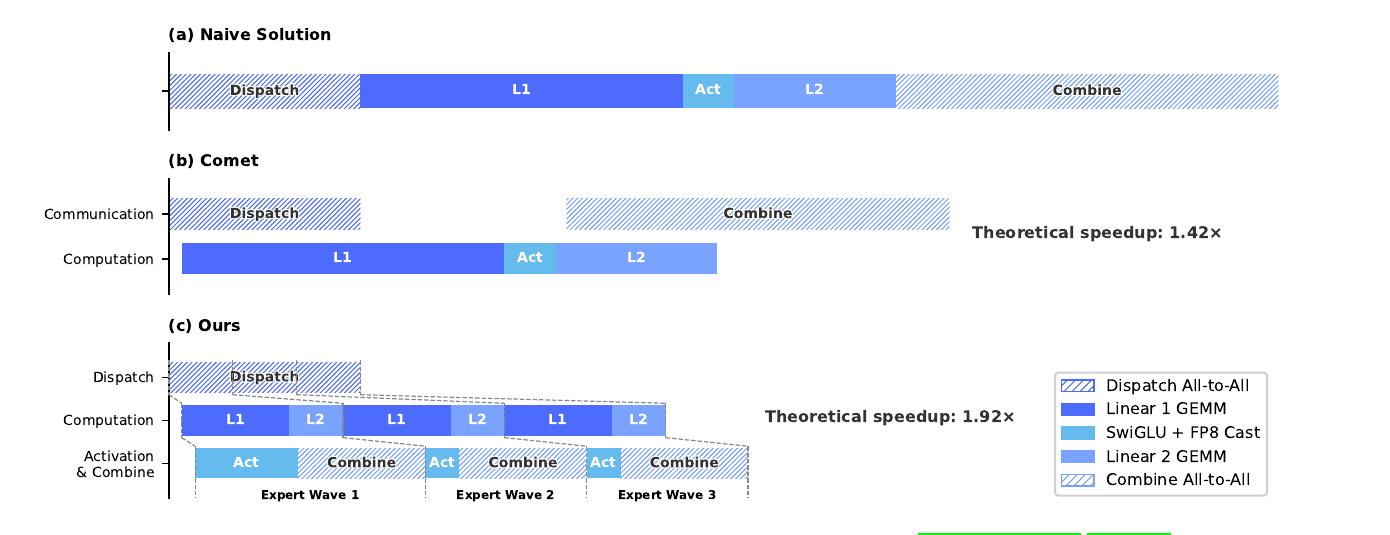
EP overlap waves
paper Fig 5 — naive vs Comet vs V4's wave-based EP scheme. Splitting experts into waves so all-to-all of next wave hides under linear-1/2 of current.

why each is exciting

GShard 2020 2006.16668 Switch 2021 2101.03961 TUTEL 2022 2206.03382 COMET 2025 2502.19811 TileLang 2025 2504.17577 FP8-LM 2023 2310.18313 Triton 2021 2107.13042 Defeating Nondet. — Thinking Machines Sept 2025 3FS — github.com/deepseek-ai/3FS

9 · pre-training

data, schedule, stability


data (32–33 T tokens)

  • builds on V3 corpus; long-document curation emphasized
  • filters batched auto-generated / templated web content (Zhu+ 2024)
  • more multilingual (long-tail cultures), more scientific/tech
  • agentic data injected at mid-training for code
  • vocab 128K; FIM + token-splitting from V3; sample-level attention masking

schedule

  • batch warmup → 75.5M (Flash) / 94.4M (Pro) tokens
  • seq length: 4K → 16K → 64K → 1M
  • attention sparsity introduced only at 64K, after dense warmup
  • indexer warm-up before turning on top-k selection
  • cosine decay near the end; MTP loss 0.3 → 0.1 at LR decay

stability lessons

10 · base-model results

V4-Flash-Base ≥ V3.2-Base on most benchmarks at 13B activated


benchmarkV3.2-Base (37B) V4-Flash-Base (13B)V4-Pro-Base (49B)
MMLU (5-shot)87.888.790.1
MMLU-Pro65.568.373.5
SimpleQA-verified28.330.155.2
SuperGPQA45.046.553.9
FACTS-Parametric27.133.962.6
HumanEval62.869.576.8
GSM8K91.190.892.6
MATH60.557.464.5
LongBench-V240.244.751.5

Flash matches or beats V3.2 with ~1/3 the activated params; Pro raises every category, especially knowledge & long context.

11 · post-training pipeline

specialists, then merge by on-policy distillation


stage 1 — specialist training

  • per domain (math, code, agent, instruction-follow): SFT → RL with GRPO (Shao+ 2024)
  • three reasoning effort modes trained with different length penalties: non-think think-high think-max
  • Generative Reward Model (GRM): actor itself plays judge for hard-to-verify tasks — direct application of GenRM (Zhang+ 2024)

stage 2 — On-Policy Distillation (OPD)

  • cited: Lu & Thinking Machines Lab, Oct 2025
  • replaces V3.2's mixed-RL stage entirely
  • student samples its own trajectories; teachers (10+) provide per-token KL feedback
  • uses full-vocabulary reverse-KL (not token-level estimate) → lower variance
  • algorithmic ancestor: MiniLLM (Gu+ 2023, on-policy reverse-KL distillation)

infra for OPD at scale

  • teacher weights live in centralized 3FS, ZeRO-sharded, loaded on demand
  • cache last-layer teacher hidden states; rebuild full logits via the prediction head on the fly (avoids materializing 100k-vocab × N-teachers logits)
  • order samples by teacher index → only one teacher head in GPU mem at a time
  • specialized TileLang KL kernel
Why it beats mixed-RL: in V3.2, math/code/chat rewards competed in one optimization ("reward conflict"). V4 trains specialists separately on clean rewards, then merges via behavioral distillation — conceptually closer to Branch-Train-Merge / Model Soups, but using token distributions, not weight averaging.

RL infra

  • FP4 rollouts; preemptible & fault-tolerant rollout service with token-granular WAL
  • DSec sandbox: container / microVM / fullVM, hundreds of thousands per cluster on 3FS
GRPO Shao+ 2024 2402.03300 PPO Schulman+ 2017 1707.06347 MiniLLM Gu+ 2023 2306.08543 GenRM Zhang+ 2024 2408.15240 LLM-as-Judge 2023 2306.05685 Self-Rewarding 2024 2401.10020 Model Soups 2022 2203.05482 BTM Li+ 2022 2208.03306

12 · reasoning modes & agent integration


three modes, one model

modeuseformat
non-thinkroutine, low-risk</think> summary
think-highcomplex, planning<think>…</think> summary
think-maxfrontier reasoning+ injected "be thorough" prompt

API-surface convergence with OpenAI's reasoning_effort and Anthropic's budget_tokens for extended thinking.

tool-call schema

  • new <|DSML|> XML format → fewer escape errors than JSON tool calls
  • interleaved thinking: reasoning preserved across tool turns within an agentic task; flushed on new user message in chat
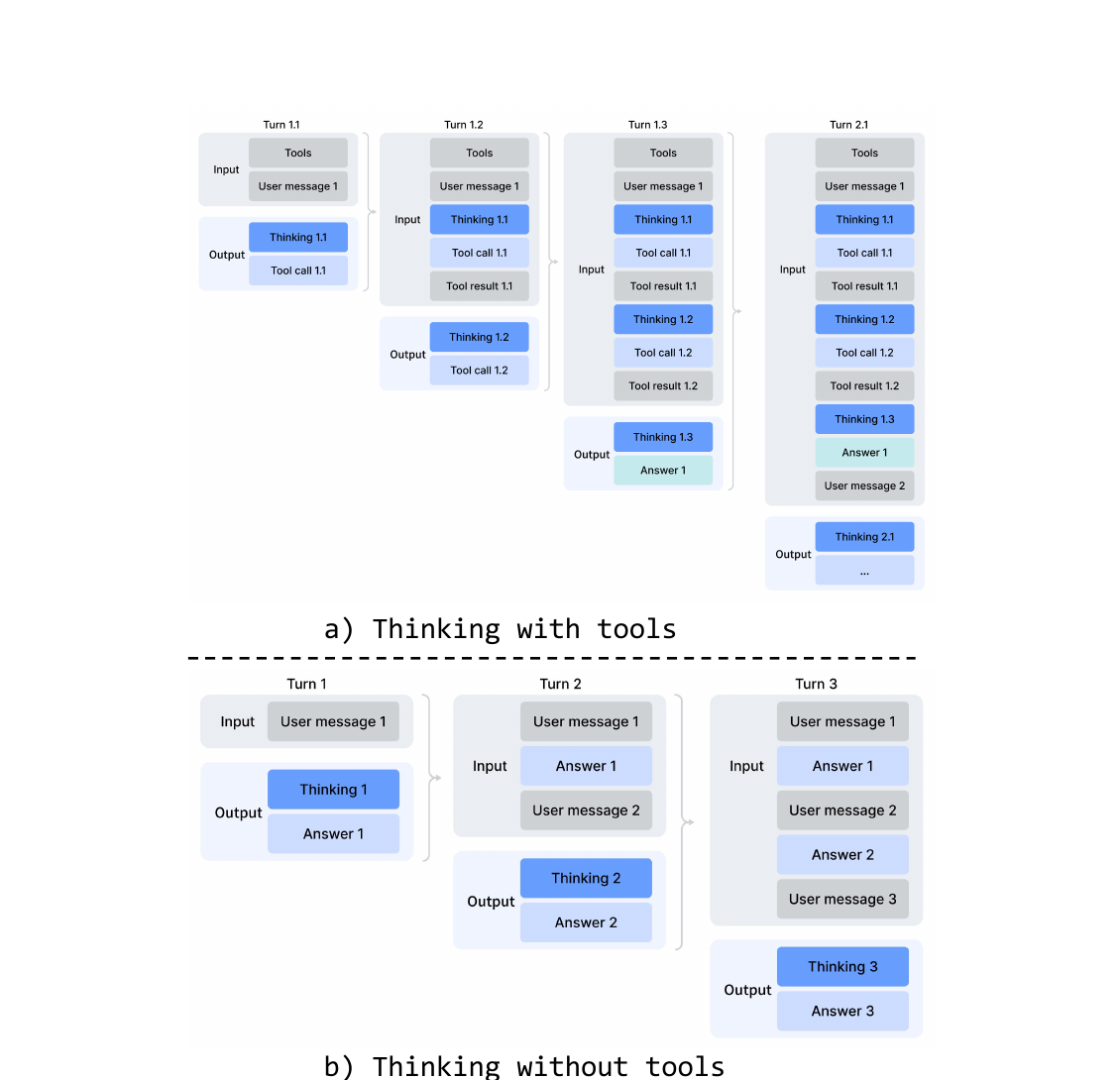
Thinking management
paper Fig 7 — left: tool-calling preserves all prior thinking; right: chat-only flushes thinking on new user message.

quick instruction

Special tokens that reuse the existing KV cache for auxiliary tasks — no separate small model, no re-prefill:

<|action|> need search? · <|query|> gen query · <|authority|> need authoritative source? · <|domain|> classify · <|extracted_url|> / <|read_url|> · <|title|> conv title

13 · headline post-trained results

V4-Pro-Max vs frontier closed/open models


benchmark Opus 4.6 MaxGPT-5.4 xHi Gemini 3.1-Pro HiK2.6 GLM-5.1DS-V4-Pro Max
MMLU-Pro89.187.591.087.186.087.5
SimpleQA-verified46.245.375.636.938.157.9
GPQA Diamond91.393.094.390.586.290.1
HLE40.039.844.436.434.737.7
LiveCodeBench88.891.789.693.5
Codeforces (rating)316830523206
Apex Shortlist85.978.189.175.572.490.2
SWE-Verified80.880.680.280.6
Terminal Bench 2.065.475.168.566.763.567.9
BrowseComp83.782.785.983.279.383.4
MRCR 1M92.976.383.5

SOTA among open models on knowledge. Lead on code/math (Codeforces 3206 ≈ rank-23 worldwide, LiveCodeBench, Apex). Trails Gemini-3.1-Pro on broad knowledge by ~3–6 months of progress.

14 · long-context behavior

1M tokens isn't just declared, it works
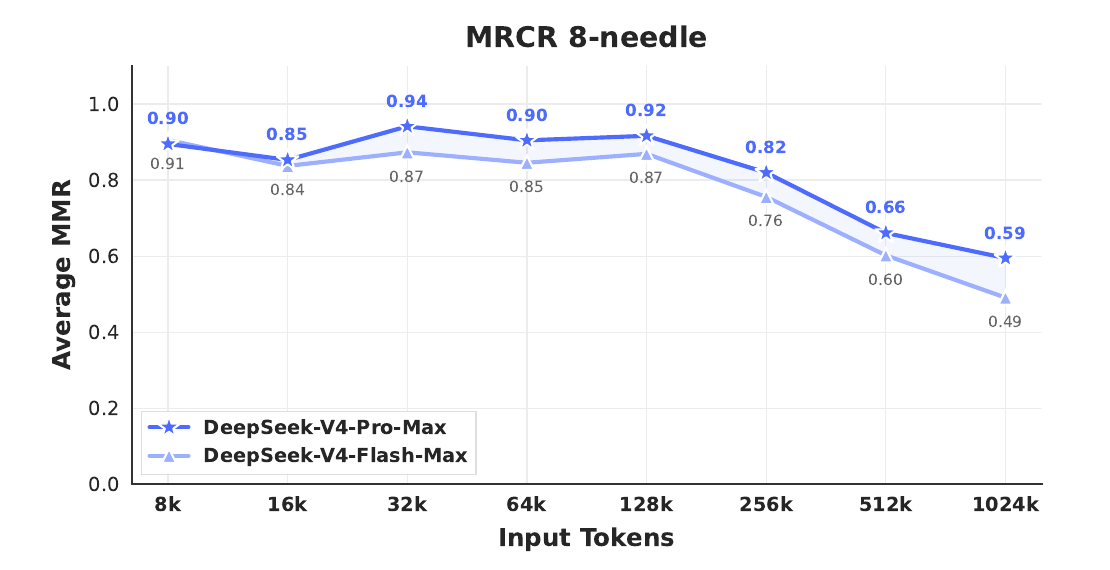

MRCR 8-needle results
paper Fig 9 — MRCR 8-needle; stable through 128K, gradual decay past 256K.

where it actually pays off

  • Codeforces 3206 (≈ rank 23 worldwide) — first open model on parity with frontier closed
  • Putnam-2025 with hybrid formal+informal: 120/120 perfect under their pipeline
  • think-max gives a real, monotonic lift on hard reasoning
  • token efficiency on HLE better than V3.2 — same accuracy, fewer thinking tokens
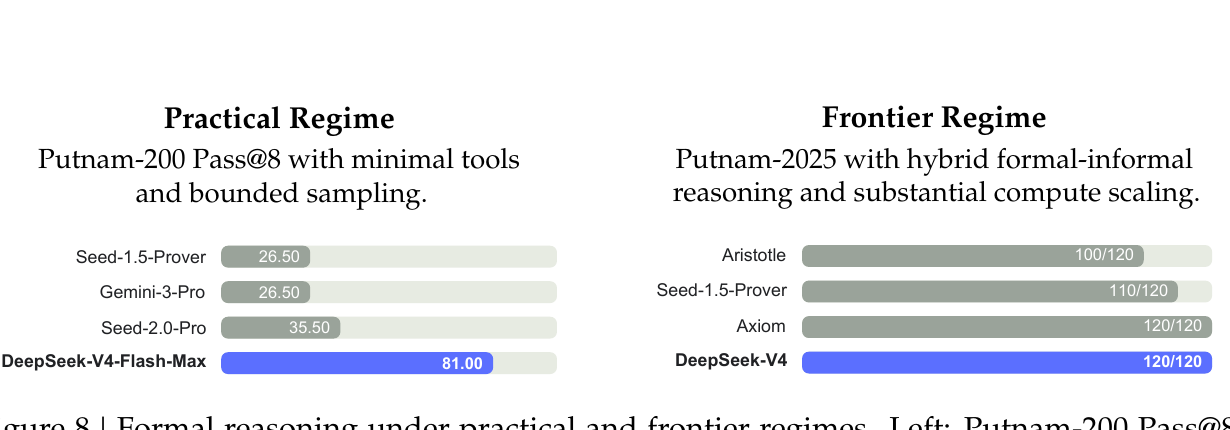
Putnam formal reasoning
paper Fig 8 — formal reasoning. Left: Putnam-200 practical regime; right: Putnam-2025 frontier regime, V4 reaches 120/120.
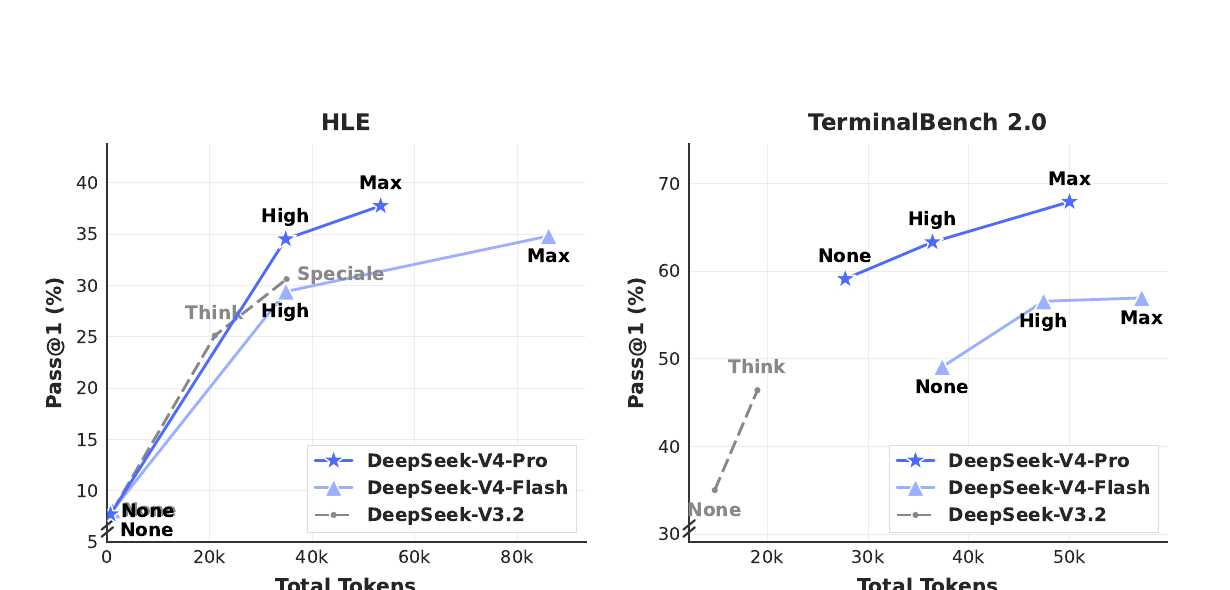
HLE and TerminalBench cost-perf
paper Fig 10 — accuracy vs cost on HLE / Terminal-Bench; V4-Pro-Max sits on the Pareto frontier among open models.

15 · takeaways


what V4 actually contributes

  • hybrid CSA / HCA — credible recipe for million-token attention at training-and-inference cost that fits open hardware. Two compression regimes interleaved is a genuinely new composition.
  • mHC — first deployment of doubly-stochastic-projected residuals at trillion scale; turns hyper-connections from research promise into production-stable.
  • Muon at 1.6T — the largest known win for the first credible AdamW challenger; with hybrid Newton-Schulz orthogonalization.
  • OPD over mixed RL — pipeline-level innovation: train specialists separately, merge by behavioral distillation. Plus full-vocab logit distillation at scale.
  • infra firsts: 1.92× EP overlap, FP4 indexer, batch-invariant deterministic train/infer parity.

where it sits

  • open SOTA on knowledge, code, math; ~3–6 months behind GPT-5.4 / Gemini-3.1-Pro on hardest reasoning
  • 1M context is real but quality drops past 256K — Opus still leads on retrieval at 1M
  • FP4×FP8 has the same peak FLOPs as FP8×FP8 today; future hardware could give another 1/3 headroom

read next

  • open inference reference: huggingface.co/deepseek-ai/DeepSeek-V4-Pro
  • V3.2 paper for DSA baseline (arXiv:2512.02556)
  • NSA (arXiv:2502.11089) — direct technical predecessor
  • HC (arXiv:2409.19606), mHC (arXiv:2512.24880)
  • Muon writeup (Jordan 2024); Liu+ 2025 (arXiv:2502.16982)
  • OPD blog — Thinking Machines Lab, Oct 2025

appendix · full reference list

everything cited in this deck, grouped


attention & long context

DeepSeek series

residuals & stability

  • He+ 2015 — ResNet · 1512.03385
  • Huang+ 2016 — DenseNet · 1608.06993
  • Birkhoff 1946 — Birkhoff polytope theorem
  • Sinkhorn 1964 / Sinkhorn-Knopp 1967
  • Cuturi 2013 — Sinkhorn distances · 1306.0895
  • Miyato+ 2018 — Spectral Norm · 1802.05957
  • Bachlechner+ 2020 — ReZero · 2003.04887
  • Zhu+ 2024 — Hyper-Connections · 2409.19606
  • Xie+ 2026 — mHC · 2512.24880

optimizer

  • Schulz 1933 — Newton-Schulz iteration
  • Loshchilov & Hutter 2017 — AdamW · 1711.05101
  • Gupta+ 2018 — Shampoo · 1802.09568
  • Jordan 2024 — Muon writeup · kellerjordan.github.io
  • Bernstein & Newhouse 2024 — Modular Duality · 2410.21265
  • Liu+ 2025 — Moonlight (Muon scalable) · 2502.16982

infrastructure

  • Lepikhin+ 2020 — GShard · 2006.16668
  • Fedus+ 2021 — Switch · 2101.03961
  • Tillet+ 2021 — Triton · 2107.13042
  • Hwang+ 2022 — TUTEL · 2206.03382
  • Peng+ 2023 — FP8-LM · 2310.18313
  • Zhang+ 2025 — COMET · 2502.19811
  • Wang+ 2025 — TileLang · 2504.17577
  • OCP MX Formats v1.0 — 2023 · opencompute.org
  • Thinking Machines 2025 — Defeating Nondeterminism in LLM Inference
  • 3FS — github.com/deepseek-ai/3FS

post-training & RL

appendix · design system

this slide is live — every control mutates the deck's CSS variables and persists with save


colors — click swatch to pick

type ramp — affects every instance of the class

components — live preview using current tokens

.card

card heading

example body text inside a card.

.stat
42stat label
.spark
a "why exciting" callout block.
.pill
default ok warn acc cite
.refs
Sample 2025 · arxiv-id Other 2024 · other-id

raw overrides — what gets baked into <style id="theme-overrides"> on save

no overrides · matches base design system
edit clean
edit log · click an entry to jump to it ×
applied   undone save = clear log + write disk
deepseek-v4 · ground-up walkthrough
1 / 1